Tuesday, December 3, 2019

Sunday, November 17


Our first snorkeling trip was shortly after breakfast.  I’d been happy to hear that the water was at its warmest this time of year and we wouldn’t need wet suits.  
Setting out on the skiff.


The fish were spectacular if you just stayed near the reef and didn’t move too much.  I had a new underwater camera so I tried that out.  The battery died after 10 minutes but in a way that was OK.  First, it meant I could focus on enjoying the fish.  Second, I knew nothing about underwater photography and got a lot of blurry blue pictures.

We were in nearly an hour and I was getting uncomfortable.  I didn’t realized how uncomfortable- later a couple on the skiff said I’d looked pretty bad and seemed almost disoriented.  I wrapped a towel around myself but was still cold.  We were soon back on the ship, where I gratefully stood under a hot shower, dressed in multiple layers and had a few cups of hot tea and finally started feeling normal again.

After lunch we went for a hike to the ranger station of a National Park.  The gift shop had a great geological map of lava flows on the island but unfortunately it was dated a few years ago so it excluded the ne last year.  The park ranger said they were working furiously to update it.

Monday, November 18- The Manta Rays


This morning’s snorkel trip was improved for many reasons.  First, I asked to check out a diving mask that had +1 diopter lenses. They made a huge difference in what I could see.  The parrot fish, in particular, were a pretty blue-green blur yesterday.  Today I could see all the variations in the colors on their bodies.  I also saw the distinctive stripes on a school of convict fish.  I had talked to one of the guides about how to take better pictures underwater; he noted the need to stay still till the fish come closer and try to get them when they weren’t moving.  Finally, I got out of the water a bit earlier than everyone else, toweled off immediately and then put on a lightweight jacket.  I warmed up very quickly.  What a relief- I’d hoped that I wouldn’t have to choose between getting hypothermia every time I went out and skipping snorkeling completely.
Three raccoon butterflyfish and one fourspot butterflyfish
Trumpet fish (at top)

Ornate butterflyfish
 
Yellow trumpet fish at center
Before lunch we had a brief presentation on Captain Cook.  He died during a skirmish in only 4 feet of water; he couldn’t swim.  It was a superstition in the Royal Navy that if your captain couldn’t swim he was more likely to be motivated to keep the ship out of danger.
After lunch our own captain told us about tonight’s passage through the Alenuihaha Channel.  Waves of up to 6 feet were expected through the night.  He reassured us that this was “a piece of cake” for the ship and the crew, but advised Dramamine if we might get seasick and reminded us to stow small electronics or anything else valuable that might fall off shelves.

During a light early dinner we had a presentation from an expert on manta rays.  From there we got into wet suits and headed out in skiffs to a site where we’d be swimming with manta rays.  
I like wet suits- they're so slimming!

They put lights in the water, which attract plankton, and the manta rays come for the plankton.  They’d emphasized that manta rays have small mouths, no teeth and they eat plankton, not humans.  

This is the closest I could get to a picture of a manta ray.  

The process was a bit uncomfortable- you had to hang onto a surfboard and look down (with mask and snorkel), trying to keep your legs straight out so you don’t hit the manta rays.  I ended up needing a “noodle” because I couldn’t keep my legs flat out no matter how hard I arched my back  They told me I didn’t have enough padding!   The guy next to me was going nuts with his Go Pro and some of the early pictures I COULD have taken would have mostly featured his rear end.  Fortunately, later in the evening the manta rays came up from the bottom and started swooping around us, under us, going in continuous ferris-wheel type loops (to scoop up plankton).  A few bumped us, they were that close.  They were generally about 12 feet across; it was spectacular.  I got only a few pictures because I kept clinging to the board, and the pictures weren’t that great, but I didn’t care!

Tuesday, November 19

In general, I love the food on UnCruise- prepared from fresh ingredients, just the right quantities and many good vegetarian options.  This, however, was the breakfast special today.  Spam is very popular in Hawaii.  I requested a veggie omelet instead.


This morning we went out on our first kayak paddle.  It felt good to get out into the boats.  We paddled around for about an hour, stopping a few times as the guide told us about the various volcanic formations.  When we came back, they’d set up a swim area behind the ship, with lines ending with “noodles” on either side.  I soon found out why they set up boundaries and ropes; I swam out a bit and getting back to the ship was WORK because of the currents.  I refused to use the rope, of course. 

I made a trip to the bridge after lunch.  UnCruise has an "open bridge" policy; passengers can visit any time during the day unless there's some sort of emergency going in.


When I commented on the paper log a crew member told me, "If it's not on paper, it didn't happen".


In the afternoon we went into an area that was a known whale sanctuary, with the caveat that it was a bit early in the season.  We did see three humpbacks; I didn’t get pictures because the best of my whale pictures usually include only a blurry tail fluke far off in the distance.  The beginning of the whale watch I used the gym equipment on the top deck while listening to my Classic Rock playlist.  I made sure to include Jimmy Buffet’s “Volcano”.  I was treated to the sight of a school of flying fish that arced over the water and submerged again.

Wednesday, November 20


This morning’s snorkel excursion was to an area off Lahaina known to be a favorite spot for sea turtles.  We’d been cautioned beforehand that they were a protected species and touching or otherwise disturbing them was prohibited- not only could offenders be subject to arrest, but the cruise line could lose its permit to take people there.  Thus forewarned, we donned our equipment and jumped in.


We were not disappointed.  Almost immediately we saw them on the sea floor, but soon a few swam into view.  In between sea turtles, I slowed down and enjoyed the fish, getting in more practice with my camera.  I noticed that the proportion of species was different here- fewer yellow tangs, for example.  

Hawaiian Sergeant Major

The guide explained that as a function of the demand for yellow tang among aquarium enthusiasts- this was an easily-accessible place to catch them.  There were also fewer parrot fish and that may have been for the same reason.  I saw one juvenile turtle swimming with an adult and saw a gathering of 5 on the sea floor but the pictures weren’t worth posting.  Sometimes you just have to enjoy what’s in front of you. I stayed in the water the whole time, nearly an hour, and warmed up easily once I got back on board the skiff. 

They brought out paddleboards when we got back.  I had tried stand-up paddleboarding in Alaska 7 years ago, which was a lot more perilous.  (Ron had reminded me how little time I’d have before dying of exposure if I fell in.)  I did manage to stay up, but not very long, and enjoyed most of the trip paddling while seated.


After lunch we anchored off Lahaina and took skiffs into town.  It was loaded with shops, of course, but I enjoyed walking around.  One bar, Fleetwood’s is owned by Mick Fleetwood and occasionally he shows up to play a few tunes.  I collected my free treat from the Banyan Tree shop ( a generous scoop of guava sherbet) with the coupon we got on the ship after completing the two things I’d wanted to do in town:  mail my Dad’s birthday card (it took 5 days to the mainland and arrived on his birthday!) and find a gold sea turtle charm for my charm bracelet.

At dinner we had a presentation by Ed Lyman, who rescues whales that become entangled in nets and other debris.  He even brought his tools to show us!  This is one of the reasons I love UnCruise- we learn so much.


Thursday, November 21- Molokai


The morning started off right- a humpback whale sighting (which I missed) and two bottlenose dolphins who rode along the bow of the ship for about 10 minutes, breaching the surface occasionally.  They looked like they were having fun!

After breakfast we had a choice of a 3-mile kayak paddle or a skiff tour.  I chose the kayak option, of course, and was paired with an Australian passenger whose wife took the skiff tour.  He took the back seat and we managed to stay ahead of nearly everyone else most of the trip- except when we stopped so I could take pictures!


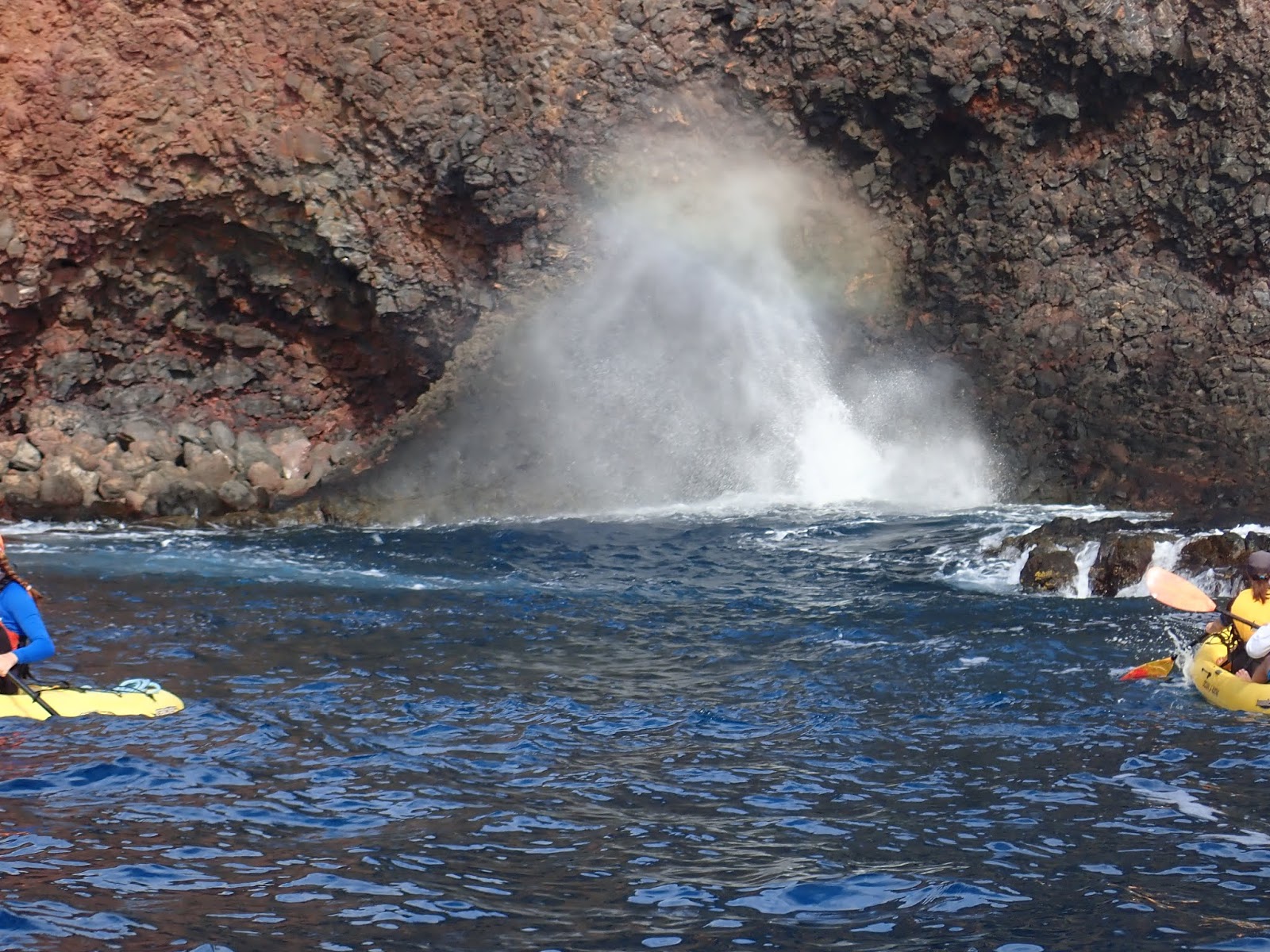
This is a blowhole; water rushes into a closed space at such pressure that the air in the space is compressed and forcefully pushes the water back out. 


They’d said we might have swimming off the boat later in the morning but then decided that conditions in an area called The Aquarium were gentle enough that we’d have an “impromptu snorkel”.  Less than half an hour after the kayak paddle I was out on the skiff to the reef with my bag of snorkel gear.

Snorkel and flippers, ready for anything.

They really did save the best for last.  There was a much wider variety of fish around the reef, and larger numbers of the same species.  I took a ton of pictures, grateful I’d had some practice on earlier trips, and got a few species I’d missed before.  I deleted about half after previewing them but was happy with some of the good results.

Achilles tang

One of the guides moves in for a closer look

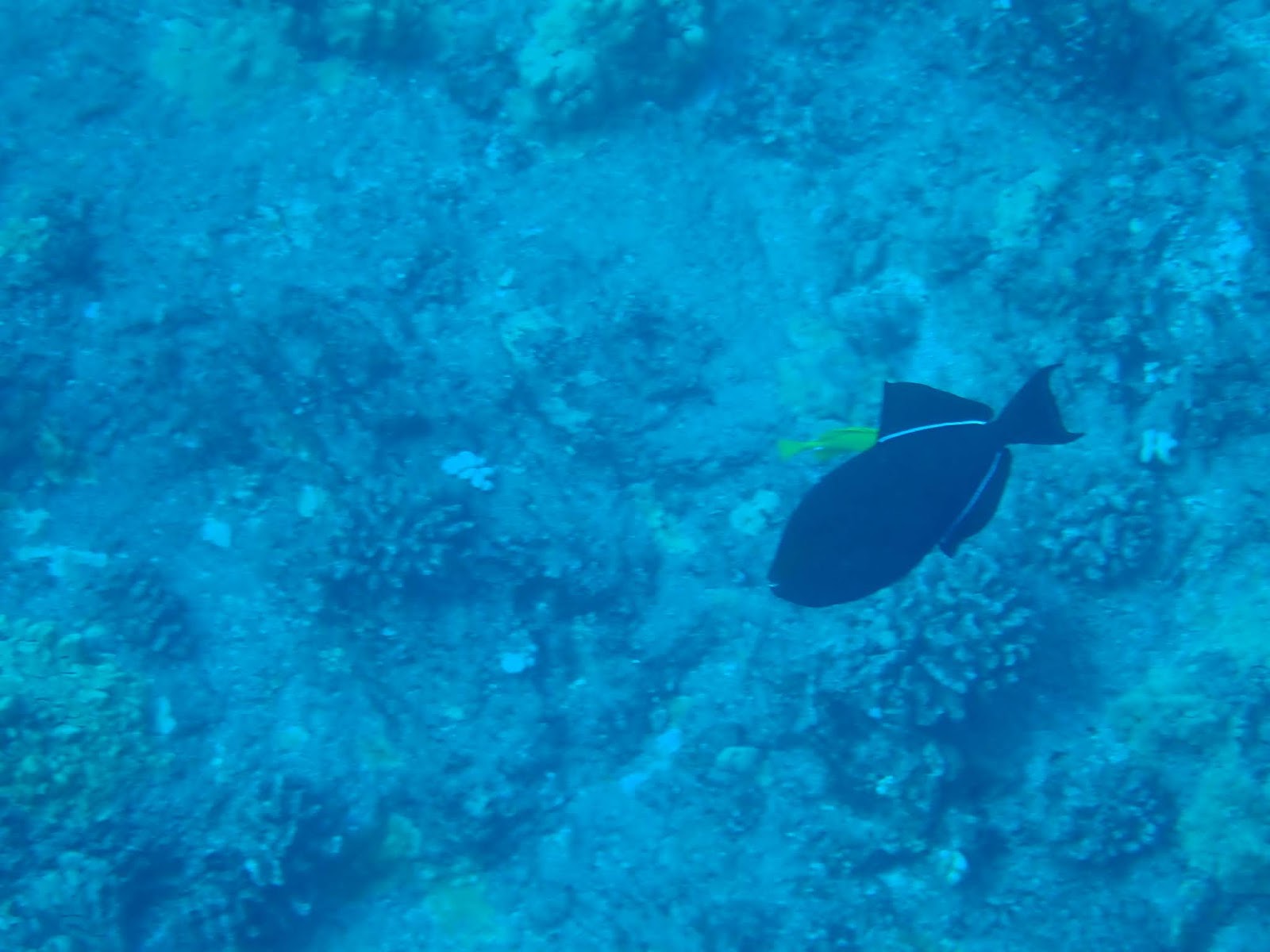
Black Durgon Triggerfish

Yellow tang

Yellow tang and parrot fish


Snorkels, fins and vests after being given a final wash by the crew.  We'd noticed that our equipment was starting to smell a little funky!
Molokai was an interesting place; it's far less developed than some of the other islands and that's intentional.  We had some time to explore it in the afternoon and I found this beautiful gecko on an equally beautiful bird-of-paradise flower.


Friday, November 22


We’d docked at Molokai early in the morning after a choppy passage the night before.  Quite a few of us had awakened around 4 AM.  

View from the road on the way up- your typical, barely-two-lanes with steep dropoff-type road.

Our choices were a hike to a waterfall with a couple of stream crossings or a hands-on presentation on Hawaiian culture and customs.  The presenters were men in their early 40s who were passionate about carrying the traditions forward.  Molokai is closer to Hawaii in its original state and they wanted to keep it that way.  UnCruise is the only company permitted to come to Molokai and it was because they’d met with the local people and asked how they could make it work.  (I heard later that some locals are disgruntled that even ONE cruise line was allowed in.)  Our small size was an advantage; Molokai has only about 7,500 inhabitants and a couple of 4,000-passenger ships in port at the same time would overwhelm the area and completely change it (and it has for many port cities).  We learned that “luau” was not the correct word for the dinner we were to have that night; that word applies to the taro leaves used in some dishes.  The correct word was pa’ine. 

One presenter was the son of the elder who had been entrusted with the details their history and customs.  His father, in his 90s, was recovering from surgery and couldn’t be there.  We left the people who wanted to attend the presentation behind and headed up the mountain.  It was muddy in spots and the first stream crossing was tricky but the guides stood in places in the stream offering strong hands as we crossed.  I did it barefoot to save my shoes from getting wet.  It was a bit hard on my feet but they recovered quickly.


We passed traces of a settlement higher up in the mountain, with a fire pit that had been carbon-dated to AD 650.  We saw nonni fruit (which smelled like rotten cheese but has medicinal purposes, including treatment of lice), breadfruit and a citrus fruit that was sharper than lemon or orange.  Mango season, unfortunately, had passed.  There was a burial ground and an area set aside for sacrifice of animals (and maybe humans- they’re not sure).  At that point a rainstorm started.  The guide said that this additional rainfall would make the second stream crossing too dangerous, so we headed back down the mountain.  It stopped after about 20 minutes. They also took us on a back path that avoided the first stream crossing.


An unexpected benefit was the driver we had on the long ride back to the ship; I’d had a different one coming in.  The road was modern but narrow, with scary views over the side and the speed limit was usually 25 mph so we took our time.  This driver got off on the subject of Father Damien and she just kept talking- we’d seen one church he’d built but he’d built many others on the island.  Before he’d arrived, people with leprosy were just taken by boat to Molokai and sent ashore.  It was partly self-preservation; the disease had already had a devastating effect on the population and they wanted to prevent further spread, but there was no support for the people who had been exiled.  Father Damien recruited a couple of others, including a Civil War veteran who wanted to do kind acts for his fellow Hawaiians after the destruction of the war, and a nun recruited from Syracuse, NY.  She had replied by letter to the appeal for people to work in Molokai and they’d actually sent someone to Syracuse to interview her- an arduous trip, but she turned out to be a hard-working right-hand person for Father Damien, who had already been diagnosed with leprosy himself.

There are still a few people remaining in the colony- cured long ago by antibiotics.  There is a lot of discussion as to what they’ll do with the land after they’re gone.  Because the area is so lush it’s very hard to keep clear.  Right now the National Park Service spends millions maintaining it and keeping the vegetation from becoming overgrown.

As we boarded the ship they collected our wet shoes and said they’d dry them overnight in the engine room!

The evening dinner was a pa’ina at a local museum. It opened with a chant from one of the musicians that sounded a lot like Gregorian chant except that it was in Hawaiian, and then a doxology that I didn’t realize was “Praise God from Whom all Blessings Flow” in Hawaiian till he was near the end.

The food was fantastic, of course- the shredded pork was the only meat other than seafood that I'd had on the entire trip and it was delicious- a mild hint of smokiness and perfectly moist after being cooked for 4 hours in an Underground oven.  They did have a hula dancer- older (maybe in her 50s), in such good shape I considered taking up hula instead of going to the gym, and very graceful.  She wore a long fitted dress rather than a grass skirt.  Later one of the male musicians did some hula while sitting in a chair.

At the end of the evening our Captain (at right) joined them.  He's very good at the guitar and the ukelele and is partial to Neil Young and Bob Marley songs. 


Saturday, November 23, 2019- Leaving the Ship and Molokai

View of our course, which was updated every day.


All good things must come to an end.  We left the ship after breakfast and were transported to a hospitality suite at the Hotel Molokai.  There were shuttles into town and I took one, planning to get lunch there.


I walked through all the stalls at the open-air market and bought yet another pair of earrings, but the restaurants were all hamburger and pizza places and, of course, coffee shops.  I realized that this is Molokai.  If they pandered to tourists and added vegan restaurants and a Starbucks, it wouldn't be the real Molokai anymore.  I went back to the hotel and had a perfectly nice lunch there instead.

A group of us left for the airport at the same time.  There were many hugs and fond farewells at the gates; this was one of the nicest groups I've ever traveled with and that's saying a lot; UnCruise tends to attract smart, curious, down-to-earth people anyway.  Maybe it was that this group was even smaller than previous trips; it was only a 36-passenger ship compared to about twice that on the others.

I loved the livery on this plane, which an aviation-nut friend told me was an updated version of a Dash-8 with apiston (not jet) engine.  He also said that the scimitar-shaped blades were a recent innovation.  In less than an hour we were back at Honolulu Airport.  I could have saved myself time and money by connecting right away to my flight home but had another night in Honolulu.